34
2nd QUARTER 2014
Debt and Equity in the
Middle Market
W
indows of opportunity in the
middle market open and shut
much faster today than they did
historically. Many experts believe
that by the end of 2014, higher yields and a
higher stock market will heighten skittishness
in capital markets. For thoughts on how
to deal with this uncertainty,
CFO Studio
invited finance executives to an Executive
Dinner on debt equity, held at The Capital
Grille in Manhattan.
Jonathan Stearns, founder of Stearns
Associated Partners, a strategic consulting and
transaction advisory firm, led the discussion.
Accounting firmRothstein Kass and legal
services firm Lowenstein Sandler sponsored
the event. Real Estate Strategies Corporation
hosted the evening, which began with a focus
on being in a position to quickly act on
opportunity when rates go lower.
Several participants described the
advantages of shelf registration in economic
climates like the current one. “When you
put up a shelf, it does create an overhang,
but the data shows that concerns about
resulting downward pressure on the stock
don’t bear out,” said Steven E. Siesser, partner
at Lowenstein Sandler. “Last year, one of
our clients pursued two transformative
acquisitions. We advised them to put a shelf
up before pursuing these deals. This enabled
us to go into the bidding process with a $100
million checkbook.”
Ed Schultz, principal at Highland Business
Group, agreed with other CFOs that many
venture capitalists are waiting to see what
the other VCs do before they even think of
investing. “Right now, I’m finding ‘A’-round
crunch to be terrific. There’s this wait-and-see
strategy.”
Who Calls the Shots?
Stearns then asked who should be driving
these types of financial decisions — the
CFO, the CEO, or the board?
“More often than not it is the CFO, but
quite frankly it depends,” said Howard Reba,
a finance executive currently advising smaller
companies on strategic and operational
matters. “That’s not a cop-out answer. Any
successful company has a team leading it; not
just one person. To me, the key to a successful
team is having complementary pieces. In some
cases, the CFOmay be the driver on some
things. In other cases, it may be the CEO.
[But] someone on the teammust be playing
point and looking after every piece.”
Schultz agreed, but added that the CFO
role should be a leading one. “The CEO, in
most cases, doesn’t have a finance background.
He or she is not going to be able to make
determinations about cash and keeping the
company liquid. In fact, many CEOs come [to
middle-market companies] from businesses
with [much larger] resources. As for the board
driving capital decisions, that can be an issue.
A lot of times, the board is from private equity,
and there is that crowd mentality there, too.
They may not know the business as well as
the CEO and the CFO. The senior partner
is thinking about the return he’s got to give
the limited partners and may want to go
ahead with some [aggressive] idea. The more
conservative person— the CFO—has to
make the final decision.”
UNCERTAINTY, OPPORTUNITY, AND PREPARATION FOR RAISING CAPITAL
IN A RAPIDLY CHANGING ECONOMY
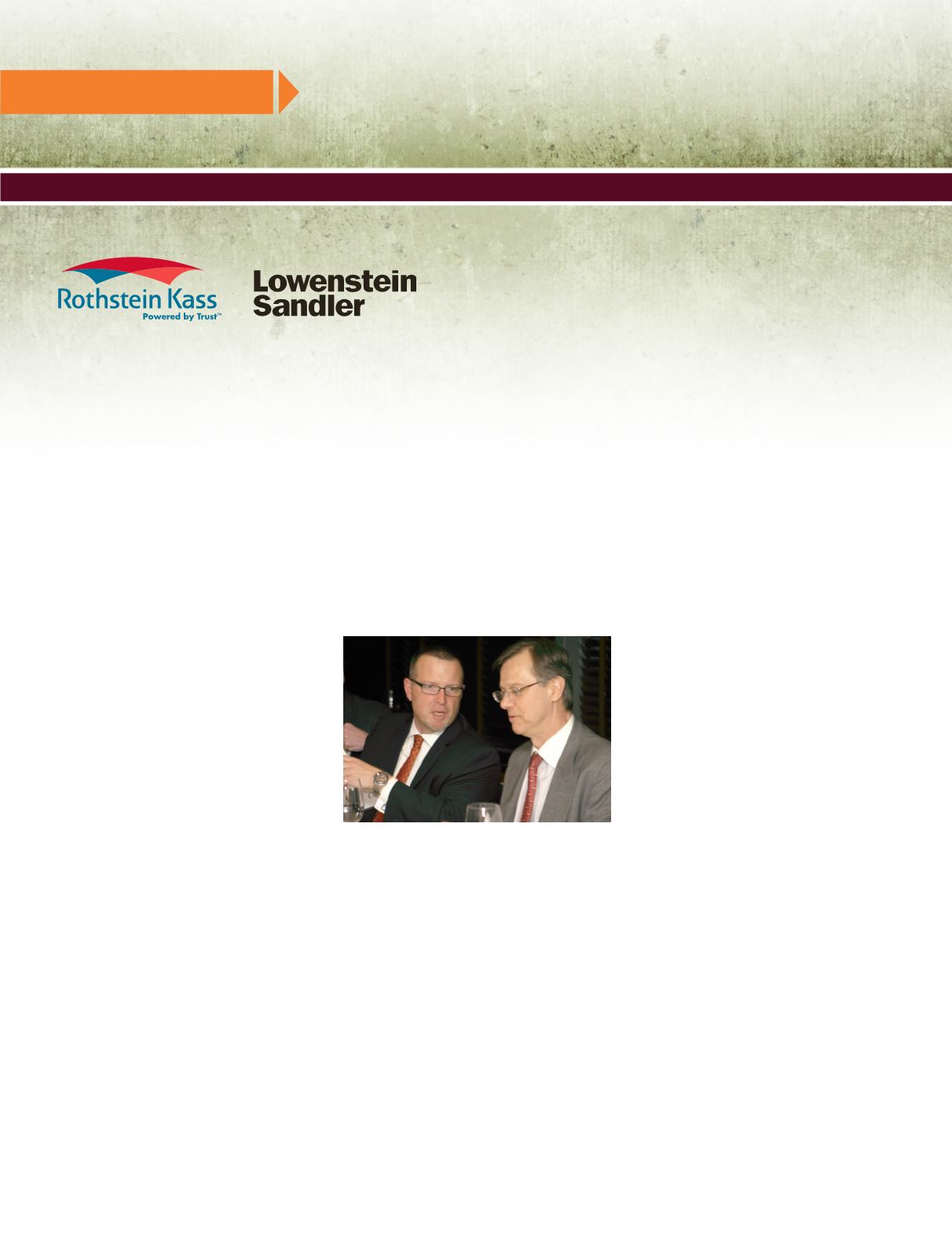
L. to R., Christopher Santomassimo, Jonathan Stearns
THIS EVENT SPONSORED BY:
CFO STUDIO
EXECUTIVE DINNER SERIES
BY DARIA MEOLI


