I
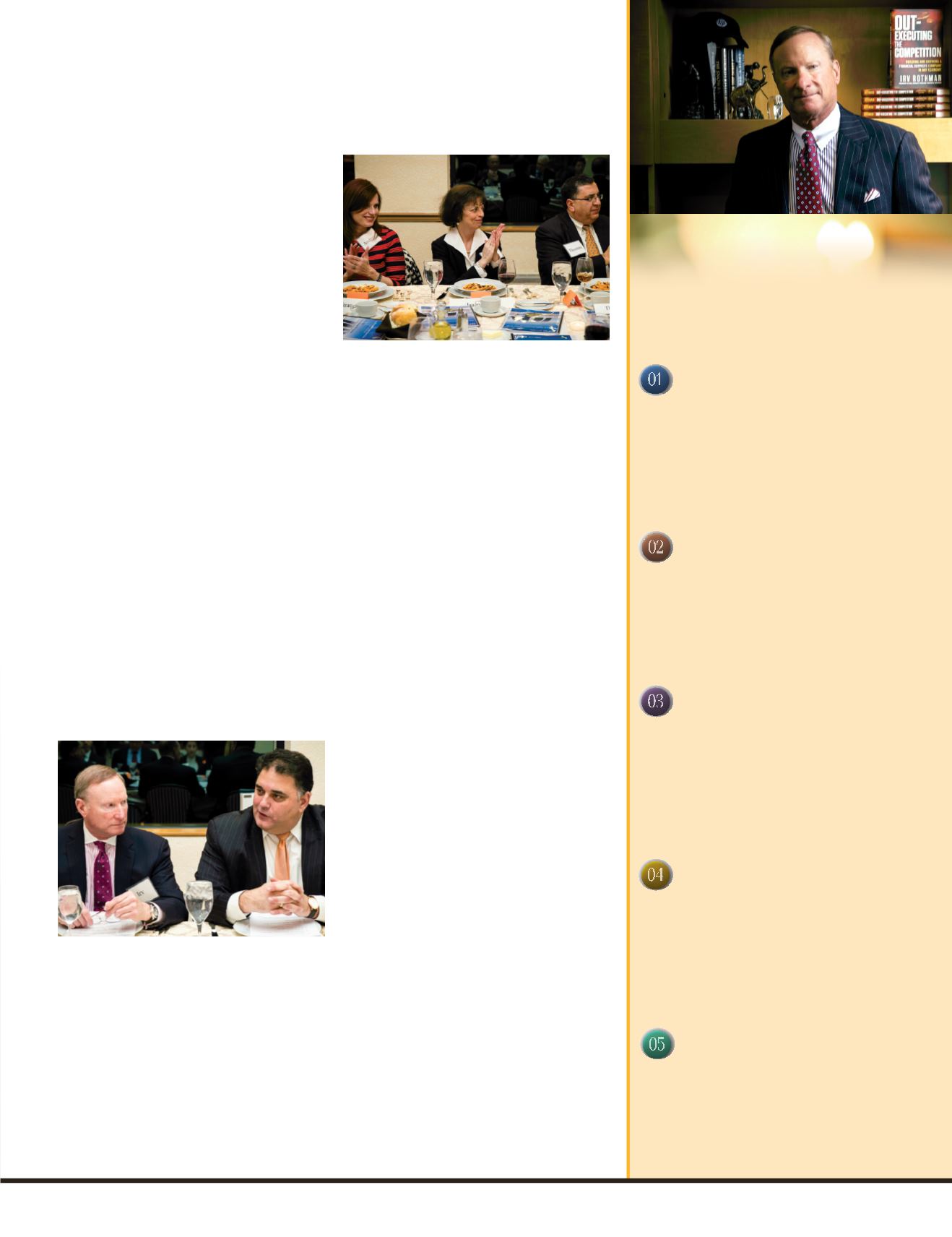
rv Rothman, president and CEO of
Hewlett-Packard Financial Services and
author of
Out-Executing the Competition
,
recently moderated a
CFO Studio
Executive Dinner Series meeting,
sponsored by Robert Half International.
The event, held at Highlawn Pavilion in West
Orange, NJ, focused on a topic with which
Rothman has firsthand experience, “From
CFO to CEO: The Next Natural CFO
Progression.” Andrew Zezas, CEO of Real
Estate Strategies Corporation, host of CFO
Studio, and publisher of
CFO Studio
magazine, hosted the event.
The dinner kicked off with Rothman
detailing his rise from CFO of AT&T Credit
Corporation to the position of president and
CEO of Hewlett-Packard Financial Services.
The conversation then turned to how other
finance executives could carve a career path
that leads to the chief executive desk.
Demonstrate a Broader
Business Perspective
According to Rothman, the key to moving
from CFO to CEO is to actively demonstrate
your value beyond finance. “You have to
place yourself in positions where you can [do
that],” said Rothman. “You exhibit broader
knowledge by sitting at the table at board
meetings, leadership team meetings, and
participating in conversations about strategy,
about M&A targets, about markets, etc., from
a point of view that is not limited to your area
of specialty.”
In order to demonstrate your knowledge
and ability when it comes to business areas
such as strategy, M&A, and markets, Rothman
and several of the other meeting participants
recommended learning how to “talk the
talk” across functions. “If you’re looking at
operations, and [your comments are all] about
debits and credits, inventory levels, and other
financial terms, you’ll only be seen as a CFO,”
said Barry Lederman, CFO at Wedgewood
Pharmacy. “You have to talk to the business
people in their own lingo regardless of the
functionality. Whether it’s operations,
marketing, or sales, you have to understand
what their business is and understand their
mindset. When you do that, you’re not seen
as just the CFO, but as a business partner, and
your relationship totally changes. Then, when
you sit at the board meetings with your col-
leagues, and they’re talking about their func-
tions, they will bring you into the discussion.
You’re brought into the dialogue differently.”
According to Zezas, many CFOs already
have responsibilities beyond finance. “The
best CFOs that we encounter are telling us
that they’re spending 20 or 30 percent of
their time on pure finance,” said Zezas. “The
rest of their time is spent on HR, managing
the legal spend, IT, logistics, manufacturing,
and sales. It’s my opinion that the best CFOs
are really COOs anyway. And, I view COOs
as CEOs in training.”
While in theory the idea of working with
other functions sounds terrific, many of the
meeting participants brought up barriers that
exist when trying to branch out. Many CFOs
have difficulty overcoming the perception
that they are just numbers folks.
“One of the keys to success is having the
right relationship with the CEO,” said
Robert Dennerlein, CFO of Dialogic.
“Number two is taking it upon yourself to
really understand the industry. Also, align
yourself closely with the head of global
sales. Take opportunities to get in front of
5 Guiding Principles from
Someone Who’s Done It
Irv Rothman leveraged a successful career in
finance to become president and CEO of Hewlett-
Packard Financial Services. Here’s his advice:
Learn to Work in Gray
Gray — ambiguity — may not feel right.
You’re a quantitative kind of person. You want the
liabilities and the assets to look the same on the
balance sheet. But the leader of an organization
must deal with ambiguity; there is no such thing
as perfect information. If you wait for perfect
information, you could miss opportunities.
Visit Customers
From the finance perspective, there’s an
in-depth knowledge of what your shareholders
want and what your bankers want, but as CEO,
you need to know what customers want. The best
way to learn is to go out and visit customers on a
regular basis while you are still CFO.
Embrace Risk
CFOs tend to be risk averse, but the world
of business today is faster and very unpredictable.
It’s much more complex than it has ever been,
and it’s globalized. If you’re not going to consider
change, you’re going to miss out on some very
important business. Be more open-minded about
evaluating, taking and managing risk.
Align Your Leadership
Skills
The organization’s operating principles and its
philosophy must guide you daily. It’s very
important that you believe in, and constantly
follow, these principles. Have conviction about
them, live them, and be consistent about role-
modeling them.
Master Communication
on All Platforms
If you’re going to be a CEO, you need to hone your
communication skills. That means platform skills,
and it means having the ability to explain a
vision, get people to rally around it, and to feel
motivated by it.
L. to R.: Andrea Citranglo, Packaging Distribution Resources;
Joanne Ferris, Applied Communication Sciences; Thomas
Bongiorno, Quest Diagnostics
L. to R.: Irv Rothman and Andrew Zezas
Photography: Jibran Aslam and Matt Furman
2nd QUARTER 2014
31


