2nd QUARTER 2014
35
Depending on the culture and the
personalities of the CFO, CEO, and board,
clear communication between the CFO and
the board is essential, participants felt.
“The best CFOs are the ones who tell
us that they’re no longer rearview-mirror
types,” said Andrew Zezas, publisher of
CFO
Studio
magazine, host of CFO Studio On-
Camera and General Counsel Studio, and
CEO of Real Estate Strategies Corporation.
“They’re no longer focused merely on
qualitative or historical reporting or
compliance. They are business executives
who use their knowledge of finance to help
their companies grow and generate profit.”
Stearns said, in his experience as both a
board member and an investor, the CFOmust
balance working with the CEO to support his
goals with providing unbiased analysis and
distilled information to the board. This is true
when weighing M&A opportunities as well as
other capital-raising issues. “If the CFO has
the ear of some of the board outside of the
CEO channel, he or she has the opportunity
to actually use soft skills to let those other
board members know whether those synergies
are really there in a potential acquisition and
whether that sales opportunity is truly going
to be reliable.”
Thomas Angell, partner at Rothstein Kass,
added that part of those necessary soft skills is
the ability to translate fromfinance to business.
“The CFO not only has to be prepared
with the right kind of data, but also the
understanding of how to translate the financial
results into a business opportunity,” he said.
Working with
Investment Bankers
The discussion moved to weighing acquisition
opportunities. Participants said the value of
investment bankers in such deals varies greatly,
depending on whether your business is on the
buy side or the sell side of the deal.
“The most important thing to remember
about investment bankers is if the deal doesn’t
close, they don’t get paid,” said Steven
Heumann, U.S. controller at ORBCOMM.
“The investment bankers may present various
debt and equity financing arrangements.
Further, these financing arrangements have to
be reviewed by management, deal modeled,
and approved by the board of directors.This
process is very time consuming and ultimately
takes time away from running the business.
Before entering into a financing agreement,
management needs to understand what type of
financing arrangement is right for its company
and its stockholders. For example, due to the
low interest rates, a company might consider
debt financing to be a better option, compared
to the cost of capital and subsequent dilution of
an equity financing. Another company might
prefer equity over a debt financing, because
they don’t have to use the cash generated by
operations to pay down the debt.”
Stearns added a different perspective. “I
think there’s a way to use investment bankers
as information people,” he said. “Not only for
the buy and sell, but also, think about utilizing
investment bankers when raising debt. They
could be incredibly productive conduits of
information as to, ‘Is a window of opportunity
opening? What’s the general spread right
now?’ Investment bankers can be very efficient
parts of helping you evaluate if your company
has appropriate capital. You can use them as
an information matrix.”
In the end, most of the executives at the
table agreed that while the decision maker in
matters of debt and equity varies, the CFO is
integral in making sure the desires of both the
board and the CEO lead to financially sound
decisions for the business.
Reba summed up: “We all agree that a
CFO has the technical skills to do the
analysis and use the information as best
as available [to make the best capital
decisions]; but equally important, if not
more important, are the CFO’s soft skills.
He needs to be able to communicate and
explain his recommendations, and try to
say yes, but sometimes has to say no. The
CFO has to take the role of the impartial
presenter of clear and concise facts.”
C
Attend CFO Studio Boardroom Roundtables and Executive Dinner Series Meetings
Find out more at
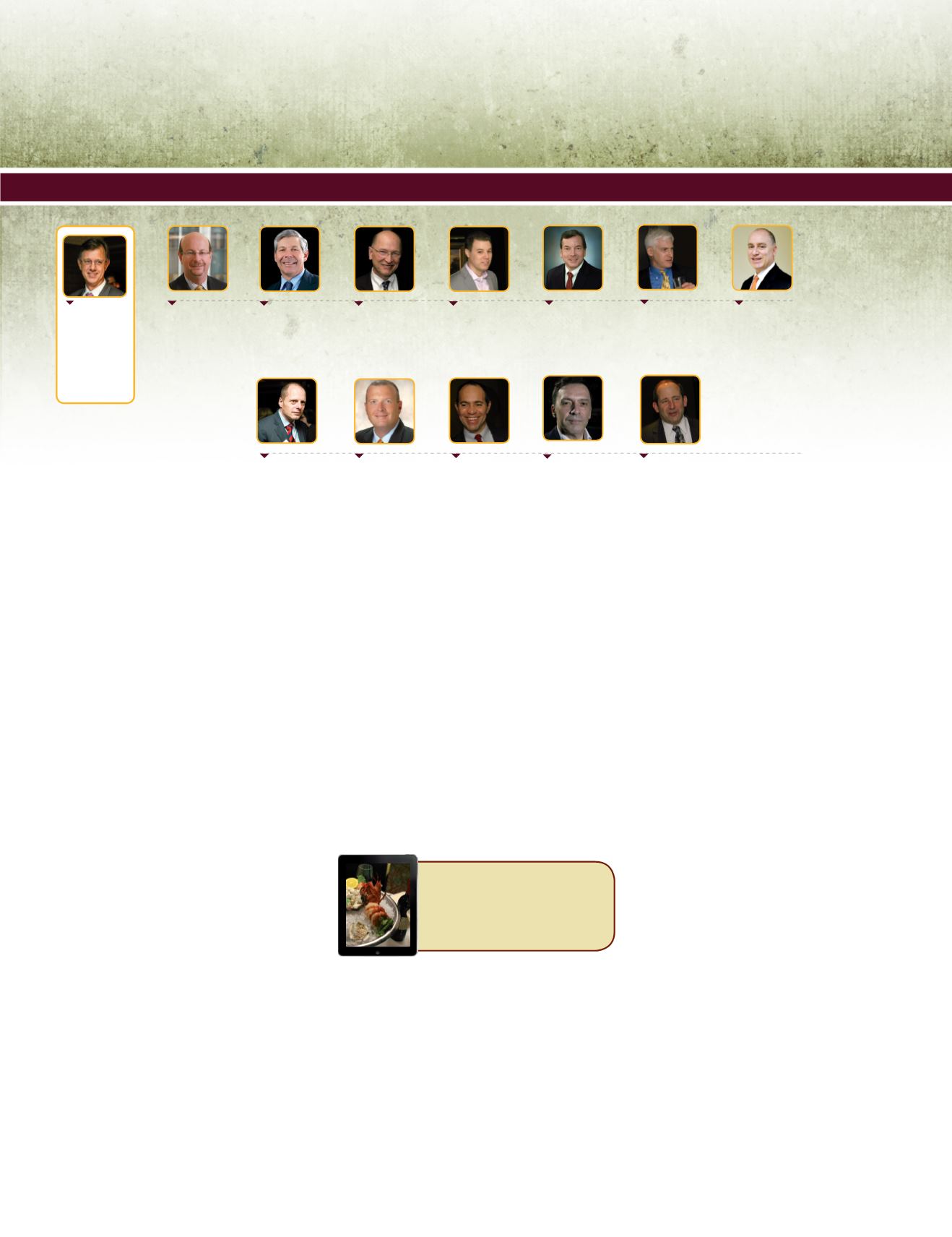
Executive Dinner Series Participants
For a review of The Capital Grille
and a more in-depth report
of the conversation, go to
Christopher
Santomassimo,
Esq., Agfa Corp.
Thomas Angell,
Rothstein
Kass
Tim Anglim,
YesCFO
Sponsor
Chris Felice,
Raven Capital
Management
Ed Shultz,
Highland
Business Group
Steven E.
Siesser,
Lowenstein
Sandler
Sponsor
Andrew
Savadelis
Ed
Sitar
Howard
Reba
Andreas Rothe,
Harsco
Infrastructure
Steven
Heumann,
ORBCOMM
Brian Giambagno,
The Action
Environmental
Group
Jonathan
Stearns,
Stearns
Associated
Partners


