Exclusively on cfostudio.com
For more insights and ideas from this CFO Studio Executive Dinner, visit CFOStudio.com for the expanded article and to see what
Richard Veldran, Lisa VanPatten
, and others added to the conversation.
32
2nd QUARTER 2014
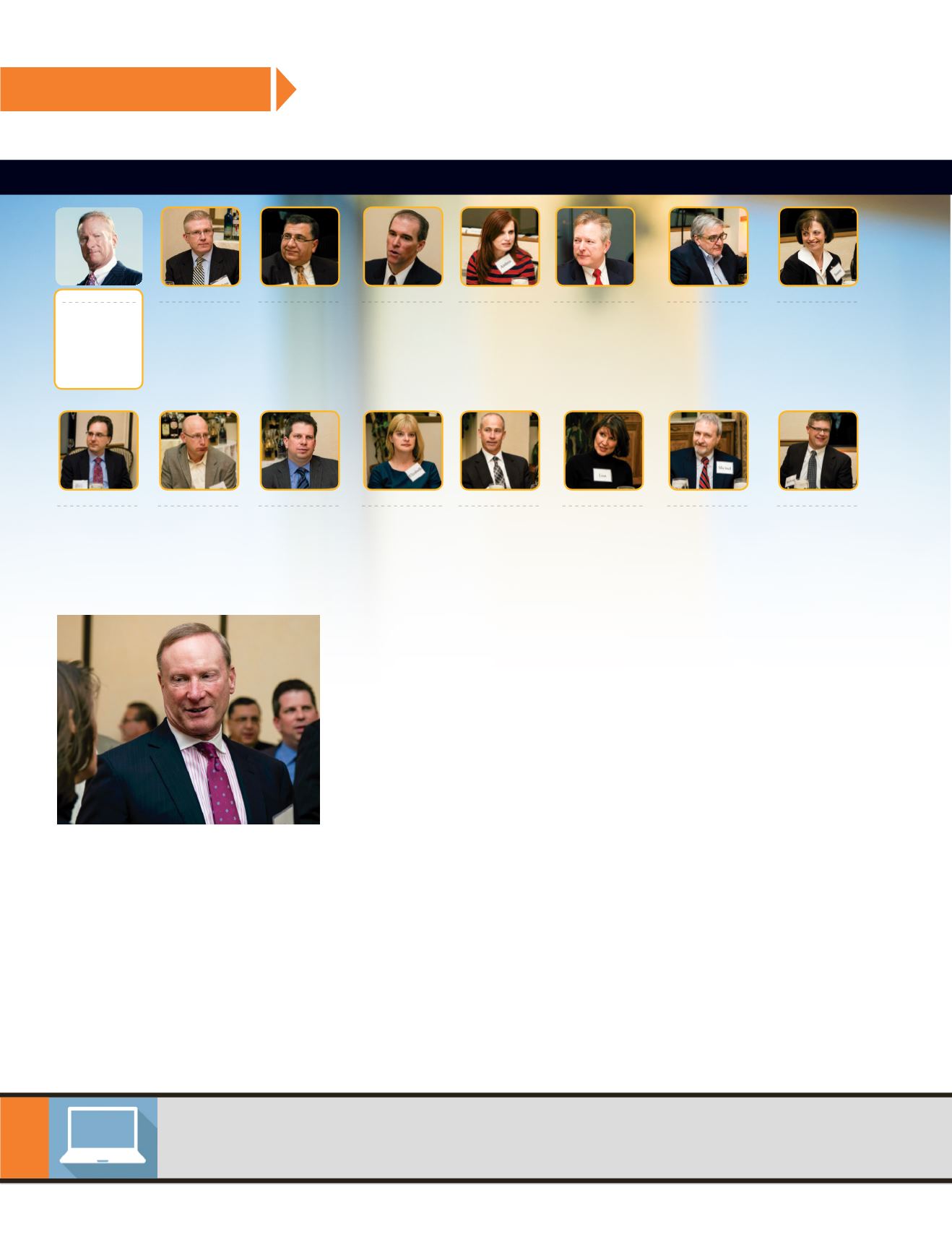
Executive Dinner Series Participants
Irv Rothman
President and
CEO, Hewlett-
Packard Financial
Services
William Flynn
Chief Financial
Officer, Sharp Elec-
tronics Corporation
Gregg Kam
Chief Financial
Officer, The Newark
Group
Barry Lederman
Chief Financial
Officer, Wedgewood
Pharmacy
Elizabeth Miller
VP of Finance &
Treasurer, Mauser
USA, LLC
Steve Mullin
Chief Financial
Officer, Wurth USA
Lisa VanPatten
Chief Financial
Officer, Kitara Media
Michael VanPatten
Chief Financial
Officer, Princeton
Power Systems
Richard Veldran
Chief Financial
Officer, Dun &
Bradstreet
Matthew Durkin
Branch Manager,
Robert Half
Sponsor
Thomas Bongiorno
Vice President,
Corporate Controller,
and Chief Account-
ing Officer, Quest
Diagnostics
Ray Cardonne
Chief Financial
Officer, DLB
Associates
Andrea Citranglo
Chief Financial
Officer,
Packaging
Distribution
Resources
Robert Dennerlein
Chief Financial
Officer, Dialogics
Michael Dentici
Chief Financial
Officer, T&M
Associates
Joanne Ferris
Chief Financial
Officer, Applied
Communication
Sciences
the customers as well as the sales
organization, and empathize with them.”
Make Your Own Opportunities
What if a CEO and other members of an
executive team don’t support the CFO’s
efforts to grow into a business position with
broader responsibilities? Lederman’s advice:
Go someplace else.
“You have to have both an internal and
external vision,” saidMatthewDurkin, branch
manager at Robert Half. “Internally, you really
need to know the company that you’re involved
in, and what every division is up to.Then
externally, you have tomake other contacts
and networking affiliations that [will help] you
make other opportunities for yourself.”
The days of management development
programs and rotations may be over. “More
and more companies today feel you are
responsible for managing your own career,”
said Rothman. “You have to speak up and say
you want to get involved with other areas of the
business. You have to say that when you travel,
you want to see some customers and learnmore
about what you’re selling, why you’re selling it,
and why customers are buying it.”
Are You Ready to Be the
Public Face of the Company?
While the CFO holds probably the second
most visible position in the organization,
taking the step into the CEO role brings on a
much brighter spotlight.
Steve Mullin is CFO of Wurth USA and
was previously president of a division of
Panasonic. He was asked to take the presi-
dent’s role while he was CFO and VP of
operations for a multibillion-dollar division
of Panasonic. “It was the best experience of
my life but there are a lot of new challenges,
so be prepared,” said Mullin. “You now are
the face of the company internally as well as
to the market, ‘head cheerleader,’ so to speak.
To be successful, among other things, it takes
high energy to hone and utilize different
personality attributes than that of a CFO.”
Even if you regularly meet with the
customers, talk toWall Street, and have had
business roles before becoming CFO, you
must also demonstrate the ability to lead. “Of
all the things that have to be demonstrated if
you want to be considered for a CEO position,
leadership is key,” said Rothman. “You’ve got
to have the ability to get people to follow you
when you say, ‘This is what we’re doing. This is
why we’re doing it, and this is how we’re going
to win in the marketplace.’”
C
Irv Rothman, President & CEO, Hewlett-Packard Financial
Services moved to HPFS from a CFO position
CFO STUDIO
EXECUTIVE DINNER SERIES


