26
2nd QUARTER 2014
law, it’s hard to see the best answers.
Besides advising on technological,
regulatory, and FDA issues, Goldberg says,
he and the legal team at Nestlé, in Florham
Park, NJ, get involved in the product
development cycle, from concept through
commercialization. Goldberg calls
this “strategic embededness,” and
it makes the GC a true business
partner. His interest in the product
goes way beyond just patents, he
says. The GC wants to see the
process from beginning to end
to help “advance the speed of
development.”
A general counsel can be of great strategic
value to his or her company by looking at things
inmultiple ways, frommany sides, says Michael
Keefe, executive vice president andGC,
MISTRAS Group Inc., in Princeton Junction,
NJ. In law school, lawyers are taught to consider
the many facets of a situation. CFOs need to act
within strict rules, some of which are overseen
by outside auditors, says Keefe. Attorneys, of
course, have ethical obligations, and need to
always advise the company to act within the
law, but have been trained to understandmost
situations have many sides and can be looked at
several ways.
Nevertheless, bothCFOandGChave a
mandate to act with the company’s best interests
inmind and can do that better together than
either can separately. Moreover, bothCFOs
andGCs are highly evolved riskmanagers who
bring to the company very different perspectives
on risk management. To present the GC
viewpoint,
CFO Studio
interviewed several
general counsels for this article (go to www.
CFOstudio.com for bios). CFOs may not
agree with every opinion they expressed.
Complementary Disciplines
“Many decisions, if they are to be truly
informed decisions — by either the CEO or
the board — are multidisciplinary in nature,”
says William Farran, vice president, general
counsel, and secretary of Innophos, Inc., in
Cranbury, NJ. “I think being a team member
has a lot to do with understanding one’s
role and what the mission is” in relation to
others, especially on a management team.
He goes on to say that a GC and a CFO
must understand that, to succeed, they can
collectively deliver the greatest value by
collaborating to achieve the team’s objectives
and must bring to bear their respective
disciplines to ensure that all decisions
are based on balanced intelligence.
He points out, there are often
additional aspects to decision-making
beyond finance and legal matters.
So, frequently HR will sit in on
meetings, and often other members
of the leadership team will need to be
involved, too.
Working together on a project, a GC
and a CFOneed to thoroughly discuss
their viewpoints, so they can “research and
determine the best decision,” says Keefe. As
an example, a proposed acquisition presents
numerous points for discussion: Does it make
financial sense? Is there undue risk? Are there
existing litigation issues? Even if you get an
indemnity agreement from the other party,
how good will it be? If the acquisition brings to
the company a different line of business, what
compliance or other issues will that raise?
“GCs must provide the wide range of
legal options open to management to meet
strategic objectives,” says Germana. “CFOs
can then best determine which among the
possibilities may likely provide the greatest
return on investment. Even that which seems
to defy logic can be ‘legal.’ Conversely, sound
business decisions can violate a host of
laws and regulations.” He adds, “By having
early tie-in between the finance and legal
departments, the right hand knows what the
left hand is doing.”
In its hospital systemwith two campuses,
says Germana, Trinitas developed a good
contracting policy, “driven by our finance
department. They would say, ‘As the lawyer
drafting these contracts you’re working with
the administrator [on the ins and outs of an
agreement], and next thing you know we, in
finance, are paying the bills…We want buy-in,
we want certain parameters to be addressed.
If there is no immediate return on investment,
when will it happen?’ ”
This Legal
Department
Earns Its
Keep
A
t Nestlé
Nutrition, the
legal and
finance functions
are true partners,
and as an example
the CFO, Matt
Reindel, with whom
GC Kevin Goldberg
works closely and
effectively, sits
down with Goldberg
periodically to review
opportunities where
legal can bring money
and value into the
company.
“My legal
department is a
profit center,” says
Goldberg.
Its revenues come
from opportunities to
make the company
whole, reviewing tax
liabilities (such as
when “we enter into
renaissance zone
agreements with
state governments,”
and revaluation of
assets. This brings
great opportunities
and yields “millions,
or some years, tens
of millions of dollars
of revenue that would
not otherwise be
here.”
On the other hand,
the legal department
is frequently called
on to defend
Nestlé in frivolous
or opportunistic
lawsuits that can
unwarrantedly “harm
our reputation even if
we are successful,”
he says. “We know
how to win against
these suits, but we
spend a lot of money
winning them, and
you can’t stop firms
from filing them.”
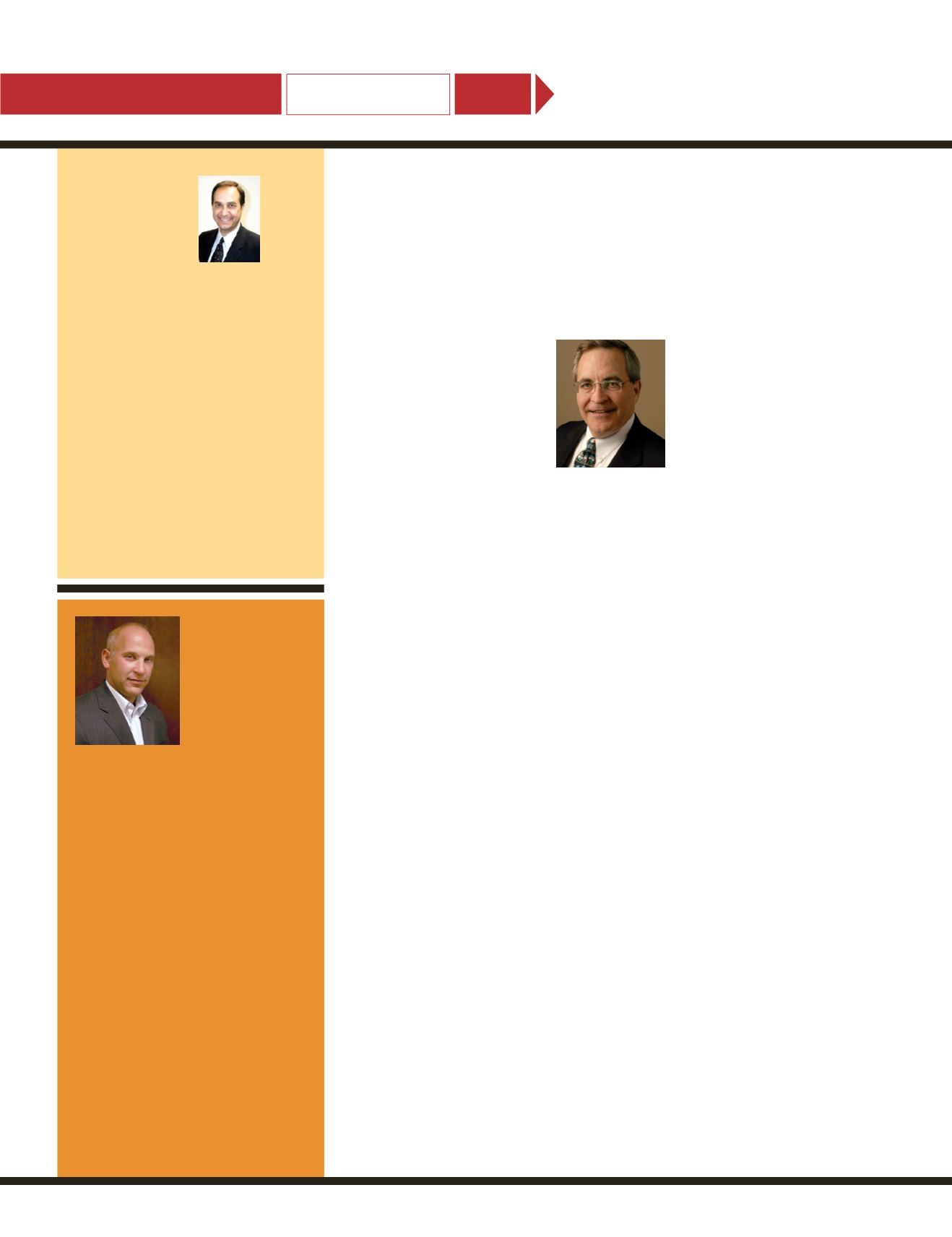
Kevin
Goldberg
William Farran
Cooperation
Is Key
A
t Trinitas
Hospital System,
a key business
issue is negotiating
physician contracts
that are not in violation
of the Stark law, which
bars referring a patient
to a medical facility in
which the physician
has a financial interest.
In trying to satisfy
one need, hospital
administration might
create an arrangement
that would lose money
for a period.
Sam Germana,
vp and general
counsel for Trinitas,
says it’s best to get
all the parties in
the room together:
finance, legal, and
administration.
“I’ll say, ‘John, the CFO
says these numbers
don’t work.’ And the
manager may respond,
‘But do you realize,
we have to do this
strategically — or lose
this line of service to
a competitor down the
road.’
“There are nuances
such as community
benefit,” Germana
says. Unless everyone
is working together on
not just the strategy
but also the contract,
some of the questions
won’t get asked, and
opportunities will be
missed.
Sam
Germana
INTERACTING
WITH THE
CFO


